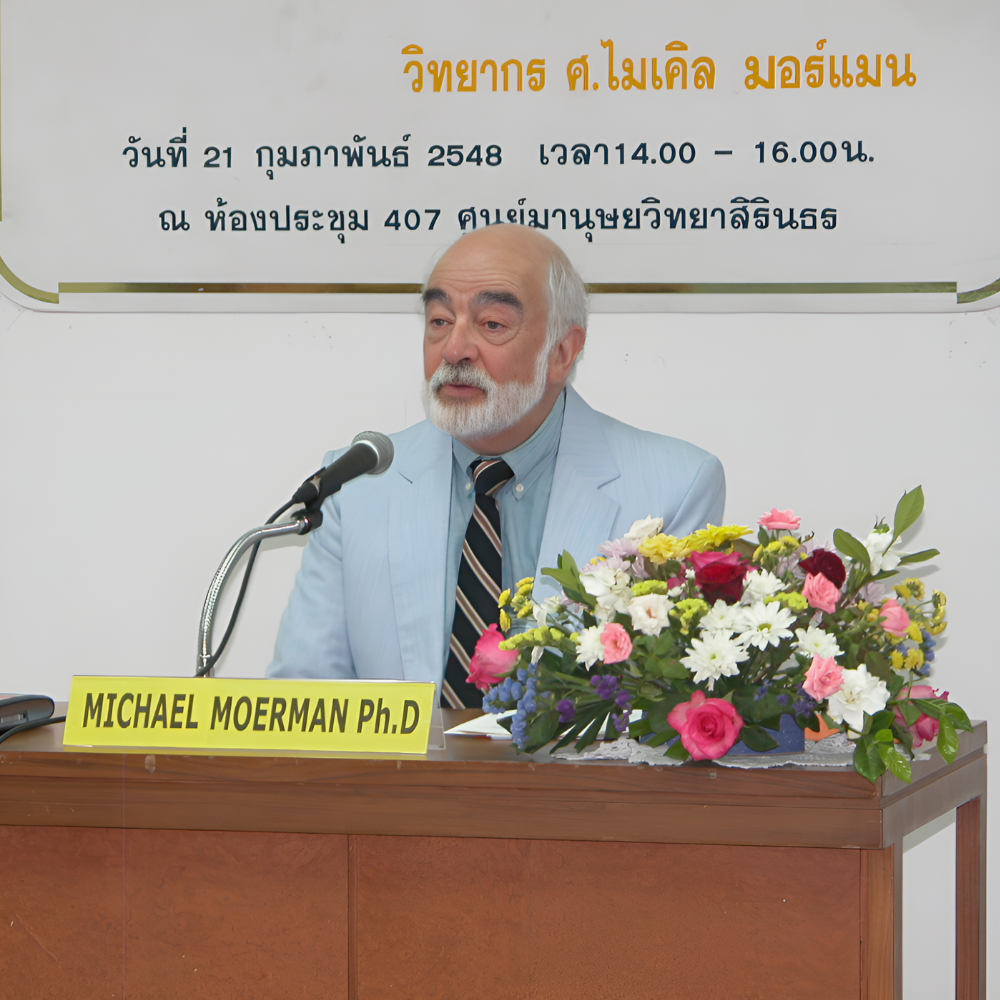
Michael Moerman, the American anthropologist who are interested in minority group in SEA. From 1959-1987, he has ever worked on a research about Tai Lue in Thailand. Moerman graduated from Columbia College with bachelor degree in Anthropology and Doctor of Philosophy from Yale University in Anthropology as well. He started his career as a teacher at American University, Washington, D.C. in 1962. After that, in 1968, moved to University of California, Los Angeles, where he worked until his retirement in 1993. According to his interest in the minority group in SEA, he did fieldwork to gather the data about the minority group in Thailand, Philippine, Indonesia, Malaysia. He is also a consultant, researcher and Invited lecturer for several academies. For example, a consultant of Journal of Asian Studies, 1965-1967, invited researcher of Australian National University, 1981-1983, invited researcher of Kyoto National University, 1992-1993, Invited lecturer at Princess Maha Chakri Sirindhorn Anthropology Centre, 2005 etc. Beside these he is also a consultant in birth control. After retirement, he is an actress and drama writer.
Michael Moerman’s fieldwork materials were created when he conducted his research about Thai Lue at Ban Phad, Payoa province between 1958 and 1989. This collection also contains materials from the study of administration of justice in Northern Thailand between 1967 and 1968. This collection includes research materials 5655 records.It consist of records of slide, photograph, punch card, letter, notebook, typescript, map, postcard, and motion picture.

